










Drosera rotundifolia (L)
Synonyms: dewplant, rosee du soleil, round-leaved sundew, red rot, lustwort, youthwort
Order: Droseraceae
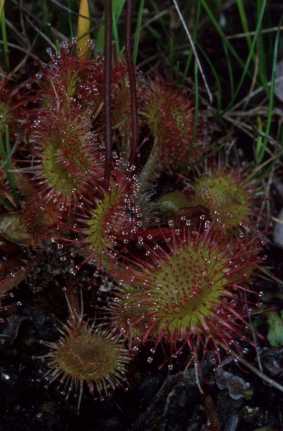
Description: Drosera is a well-known insect-eating plant with long-stalked round leaves covered on the upper surface with long red hairs with small glands on the tips. The white flowers are arranged in a unilateral raceme at the end of the smooth, slender flowerstems and they open out in sunlight. The plant grows in bogs and in wet ground throughout Britain, Europe, northern Asia and North America.
Parts used: the whole plant
Collection: during the flowering period in July or August.
Constituents: naphthaquinones (including plumbagin), flavonoids, tannins, citric acid, malic acid
Actions: antispasmodic, antitussive, demulcent, relaxing expectorant, appears to exert relaxing effect on bronchial musculature, antimicrobial
Indications: bronchitis, asthma, pertussis, tracheitis, gastric ulceration. Specifically indicated in asthma, chronic bronchitis with peptic ulceration or gastritis.
Therapeutics and Pharmacology: Drosera is used in the treatment of bronchitis and pertussis, dry, tickly or nervous coughs, tracheitis, and other respiratory conditions marked by viscid mucus. Its relaxing effect upon involuntary muscles helps to relieve asthma. It has also been used in the treatment of gastric inflammation and ulceration. Plumbagin has been shown to be active against streptococcus, staphylococcus and pneumococcus bacteria. A yellow crystalline substance, carboxy-oxy-naphthoquinone, has good spasmolytic properties and inhibits coughing. It has been demonstrated that a small quantity of Drosera added to thyme extract enhances this spasmolytic action.
Combinations: Drosera may be combined with Euphorbia, Grindelia or Senega in asthma.
Caution: The plant contains irritant substances and should be used only in small quantities.
Preparation and Dosage: (thrice daily)
Regulatory Status GSL
Dried plant: 1-2g or by infusion
Liquid Extract: 1:1 in 25% alcohol, 0.5-2ml
Tincture: 1:5 in 60% alcohol, 0.5-1ml
Additional Comments: Drosera is used in homoeopathy for coughs and sore throats. Chinese physicians prescribe Drosera species for dysentery, headaches and rheumatic pains.
Bibliography
BHMA 1983 British Herbal Pharmacopoeia, BHMA, Bournemouth.
Grieve, M. 1931 A Modern Herbal, (ed. C.F. Leyel 1985), London.
Hoffmann, D. 1990 The New Holistic Herbal, Second Edition, Element, Shaftesbury.
Lust, J. 1990 The Herb Book, Bantam, London.
Mills, S.Y. 1993 The A-Z of Modern Herbalism, Diamond Books, London.
Polunin, M. and Robbins, C. 1992 The Natural Pharmacy, Dorling Kindersley, London.
Weiss, R.F. 1991 Herbal Medicine, Beaconsfield Arcanum, Beaconsfield.
Wren, R.C. 1988 Potter's New Cyclopaedia of Botanical Drugs and Preparations, C.W.Daniel, Saffron Walden.